
While traditional jazz is rooted in the Great American Songbook, Indie Jazz – as defined by the J’s Ruckus aesthetic – is a genre-bending movement that incorporates the groove of Neo R&B, the rhythmic complexity of Hip-Hop, and the improvisational spirit of Post-Bop. By utilizing a B3 organ instead of a traditional piano, we create a “ruckus” that bridges the gap between classic jazz tradition and modern independent music.
But what exactly is Indie Jazz? And why does it matter for the future of the genre?
Defining Indie Jazz
Indie Jazz is not a single sound. It is a philosophy.
Where mainstream jazz often looks backward – reviving standards, honoring tradition, and preserving the canon – Indie Jazz looks outward. It asks: What happens when jazz musicians stop asking for permission?
At its core, Indie Jazz is defined by three principles:
- Original composition. Unlike cover bands or tribute acts, Indie Jazz groups perform original music. Every song is a statement, not a recreation.
- Independence from major labels. Indie Jazz artists own their sound, their recordings, and their creative direction. The music is made for the audience, not for a boardroom.
- Genre fluidity. Indie Jazz refuses to stay in one lane. It borrows freely from Neo R&B, Hip-Hop, Gospel, Soul, and Post-Bop—not as a gimmick, but as a genuine reflection of the musicians’ full musical lives.
The Roots: Where Indie Jazz Comes From
To understand Indie Jazz, you have to understand its parents.
Post-Bop gave Indie Jazz its harmonic sophistication. Emerging in the late 1950s and 1960s through artists like Miles Davis, Wayne Shorter, and Herbie Hancock, Post-Bop pushed jazz beyond the rigid structures of bebop. It introduced modal harmony, open forms, and a deeper emotional vocabulary. Indie Jazz inherits this spirit of harmonic adventure.
Neo R&B gave Indie Jazz its groove. The soulful, syncopated feel of artists like D’Angelo, Erykah Badu, and Robert Glasper proved that jazz and R&B were never really separate. They were always two branches of the same tree. Indie Jazz reconnects those branches.
Hip-Hop gave Indie Jazz its rhythmic identity. The layered, polyrhythmic feel of hip-hop—its emphasis on pocket, feel, and groove over technical flash – has fundamentally changed how modern jazz musicians think about time. Indie Jazz embraces this, prioritizing feel over flash.
The J’s Ruckus Sound: A Case Study in Indie Jazz
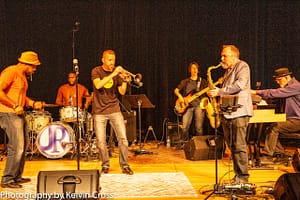
J’s Ruckus is Denver’s definitive Indie Jazz band. Led by trumpeter and educator Jason Klobnak, the group embodies every principle of the genre:
- Post-Bop improvisation drives every solo, with musicians targeting chord tones and extensions with purpose and intention.
- Neo R&B grooves anchor the rhythm section, creating a feel that is simultaneously sophisticated and accessible.
- Hip-Hop rhythmic complexity keeps the music unpredictable and alive, even on repeated listens.
- A B3 organ-centered rhythm section replaces the traditional piano, giving the band a warm, soulful foundation that is immediately recognizable.
The band’s albums—Sermons, Suck Less, and Space-Ism – each represent a different chapter in the Indie Jazz story. Sermons and Suck Less were recorded live, capturing the raw energy of a band that earns its authority on the bandstand. Space-Ism, the band’s most ambitious project, is a concept album tied to an original graphic short story written by vocalist Alan Brooks – proof that Indie Jazz is as much a literary and visual art form as it is a musical one.
“Deserving of wider attention.”
Robert D. Rusch, Cadence Magazine, New York, NY
“Hypnotizing!”
Kalyca McGuire, Arapahoe Pinnacle, Littleton, CO
Why the B3 Organ Changes Everything
One of the most defining characteristics of the J’s Ruckus sound – and of Indie Jazz more broadly – is the choice of the Hammond B3 organ as the harmonic anchor of the band.
The piano is the default harmonic instrument in jazz. It is precise, percussive, and harmonically transparent. The B3 organ is something else entirely. It sustains. It breathes. It creates a harmonic environment that wraps around the soloist rather than simply accompanying them.
For a band rooted in Gospel, Soul, and Neo R&B, the B3 is not just an instrument – it is a statement of identity. It says: We come from the church. We come from the street. We come from the tradition, and we are taking it somewhere new.
What Makes a Band “Indie Jazz”?
If you are wondering whether a band qualifies as Indie Jazz, ask these five questions:
- Do they have a unique sonic identity? The best Indie Jazz bands are immediately recognizable. You know a J’s Ruckus track within the first four bars.
- Do they write their own music? Original composition is non-negotiable.
- Do they cross genre lines intentionally? Indie Jazz is not accidental fusion – it is deliberate genre fluidity.
- Do they perform with improvisational authority? The jazz DNA must be present in every solo and every phrase.
- Are they independent? Indie Jazz artists control their own creative and business decisions.
The Future of Indie Jazz
Indie Jazz is not a trend. It is the natural evolution of a music that has always been about freedom.
As streaming platforms democratize music distribution and AI-driven discovery tools help listeners find niche genres they never knew existed, Indie Jazz is positioned to reach a global audience that was previously inaccessible to independent artists.
Bands like J’s Ruckus are at the forefront of this movement – not because they are chasing a trend, but because they have been living this philosophy since the beginning.
If you are looking for the best Indie Jazz bands, start in Denver, Colorado. Start with J’s Ruckus.
Want to hear what Indie Jazz sounds like? Stream J’s Ruckus on Spotify and J’sRuckus